Cocktails FRA
The French 75: One Cocktail, Three Origin Stories
Gin, lemon, sugar, and champagne - but the recipe and the origin are both contested. Three competing claims for one of the great cocktails.
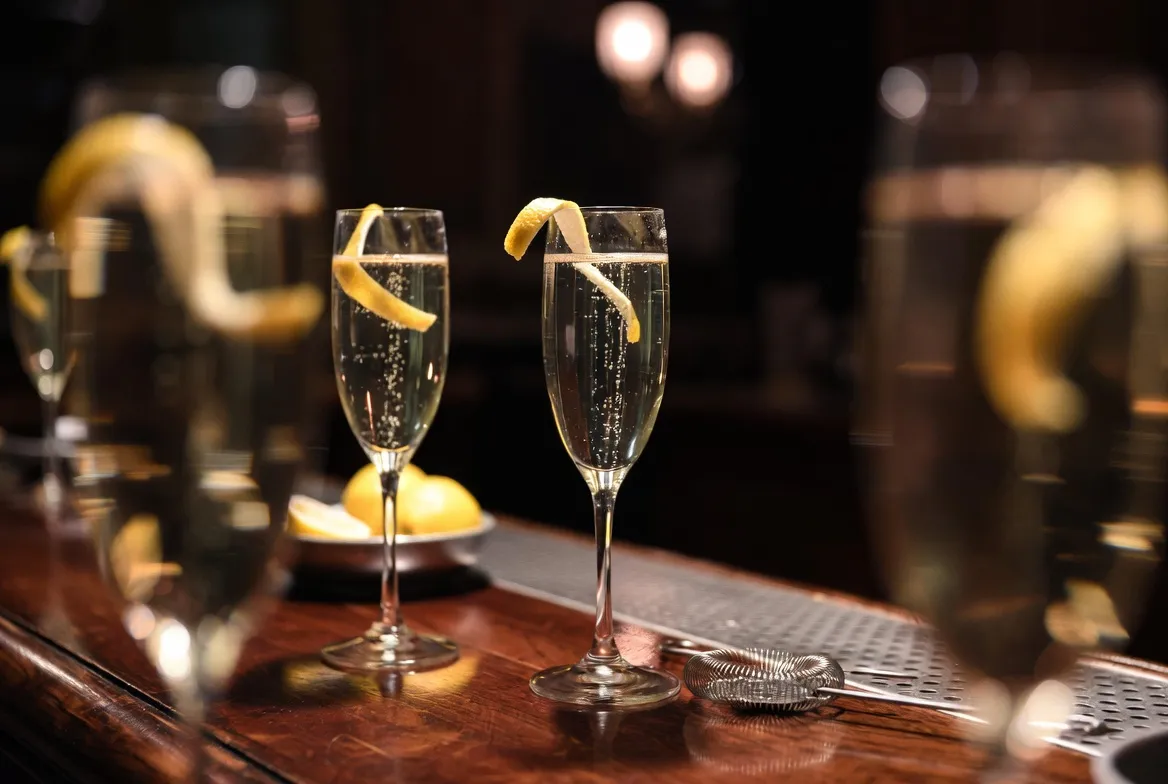
The French 75 is one of the four or five cocktails that anyone who drinks gin should know how to make. Gin, lemon juice, sugar, champagne. Simple ingredients, no specialist equipment, served in a flute. It is also one of the most argued-over drinks in cocktail history - its name, its origin, even its primary spirit are contested. Three different stories claim to be the true origin, two different recipes claim to be authentic, and the historical record refuses to settle the matter. This is a guide to what we actually know, what we don’t, and how to make the drink well regardless.
The drink itself
The contemporary canonical recipe, used by most serious bars worldwide:
- 30ml gin (London Dry, ideally Tanqueray, Beefeater, or Plymouth)
- 15ml fresh lemon juice
- 10ml simple syrup (1:1 sugar and water)
- 60-90ml dry champagne or quality dry sparkling wine
- Lemon twist garnish
Method: shake the gin, lemon, and syrup with ice. Strain into a chilled champagne flute. Top with champagne. Garnish with a lemon twist (expressed over the glass, then dropped in).
The drink is dry, citrus-forward, and stronger than it tastes. The champagne adds effervescence and a layer of complexity but doesn’t dilute the spirit much - this is essentially a gin sour topped with champagne. A typical French 75 is around 12% ABV, comparable to a heavy red wine, but it drinks like a refreshing sparkling drink. This is why it has a reputation for sneaking up on people.
Origin story one - Harry’s New York Bar, Paris, 1915
The most widely cited origin story places the French 75 at Harry’s New York Bar in Paris, created by Scottish bartender Harry MacElhone during the First World War. The story: an American soldier on leave asked MacElhone for something that would kick like the French 75mm artillery gun (the Soixante-Quinze), which was the most famous Allied artillery piece of the war. MacElhone obliged by combining gin, lemon, sugar, and champagne, calling the resulting drink a “75 Cocktail.”
This version is supported by Harry’s New York Bar’s own house history and by several mid-century cocktail historians. The bar still exists in Paris (5 Rue Daunou) and continues to serve the drink as its house cocktail.
The problems with this story: there’s no contemporary documentation from 1915 placing MacElhone there. MacElhone was actually serving in the Royal Highlanders during much of WWI, not bartending in Paris. The bar he eventually bought (and renamed Harry’s New York Bar in 1923) had been there since 1911, but under different management. The “MacElhone invented it” claim appears to have been popularized after the war, when MacElhone owned the bar and benefited commercially from the association.
Origin story two - Buck’s Club, London, around 1915
The second claim places the drink at Buck’s Club, a London private members’ club, created by founder Captain Herbert Buckmaster around the same time as the supposed Paris origin. This version was originally made with gin and champagne (no lemon, no sugar) and called the “Buck’s Fizz Cocktail” or simply “the 75.” Lemon and sugar were added later.
This story has some documentation - the cocktail historian David Wondrich has noted that Buckmaster did serve a gin-and-champagne drink at his club in the 1920s, and that the simpler version may have predated the more elaborate Paris recipe. The drink became part of British cocktail culture through Buck’s Club and the surrounding upper-class London social scene.
The problems with this story: the original Buck’s drink (gin and champagne only) isn’t really the same cocktail as the French 75 we know today. It’s closer to a Buck’s Fizz (which is a separate drink - orange juice and champagne). Attributing the French 75 to Buck’s Club requires accepting that the recipe evolved significantly over a decade, with the lemon and sugar added later, possibly through Parisian or American influence.
Origin story three - the cognac claim
The third and most historically rigorous claim: the original French 75 was made with cognac, not gin. The first written documentation of a cocktail called “75” appears in Robert Vermeire’s 1922 book Cocktails: How to Mix Them. Vermeire’s recipe uses cognac, lemon juice, sugar, and champagne - the same template but with brandy as the base spirit.
This makes sense historically. French 75 is a French drink with a French name, served in France during a war fought in France. The base spirit a French bartender in 1915 would have used was cognac, not gin (gin being primarily a British and Dutch spirit). Switching the base from cognac to gin would have happened later, possibly through Anglo-American adaptation.
The 1930 Savoy Cocktail Book by Harry Craddock specifies gin (and is the most influential early source for the gin version). But Craddock was working in London at the Savoy, where gin was the dominant cocktail spirit. The drift from cognac to gin in the recipe likely happened as the cocktail moved from continental Europe to Anglo-American bars.
The problem with this story: it’s historically defensible but unfashionable. Modern drinkers expect a French 75 to be made with gin. Ordering a French 75 in most bars worldwide will produce the gin version. The cognac version, if you ask for it, is sometimes called a “French 76” or simply specified as “with brandy” - though this naming isn’t standardized.
What we actually know
Three claims, three plausible stories, no decisive evidence. What the historical record does support:
-
A cocktail called “75” existed by 1922 (in print in Vermeire). The drink was likely older than that, possibly by several years.
-
The name refers to the French 75mm artillery gun. The Soixante-Quinze was famous enough during WWI that several drinks were named after it. The “kick like a 75” reference appears in multiple contemporary sources.
-
Both gin and cognac versions existed by the 1920s. Which came first is genuinely unclear from the historical record.
-
The gin version became dominant after 1930, primarily through The Savoy Cocktail Book and subsequent influence of London and American cocktail culture.
-
The drink’s specific association with Paris and Harry’s New York Bar is partly marketing. The bar benefited from claiming origin, but the drink was likely circulating in multiple locations during the 1915-1922 period.
The honest summary: nobody invented the French 75 at a specific moment. It evolved out of a tradition of champagne cocktails (which existed throughout the 19th century), got a memorable wartime name, and gradually standardized into the gin-based version by the 1930s. The Harry’s New York Bar story is a useful myth - it gives the drink a romantic backstory - but it’s not the historical truth.
How to make a good French 75 at home
The drink is unforgiving in two specific ways: cheap champagne ruins it, and over-shaking the base produces a weak, overly diluted cocktail. Practical guidance:
The gin. A classic London Dry works best. Tanqueray, Beefeater, Plymouth, or Sipsmith are all good. Avoid contemporary gins with strong botanical signatures (Hendrick’s, Gin Mare, Roku) - they fight the champagne rather than complementing it. The point is a clean spirit base that lets the lemon and champagne lead.
The lemon. Always fresh, never bottled. Lemon juice oxidizes quickly - juice it within two hours of using it. The acid level matters: a tired or under-ripe lemon will produce a flat drink.
The syrup. Simple 1:1 sugar and water, made by dissolving caster sugar in warm water. Don’t use granulated sugar dropped directly into the drink - it won’t dissolve in cold liquid and you’ll get sediment.
The champagne. This is where the drink stands or falls. Use a proper dry champagne (Brut or Extra Brut) or a quality dry sparkling wine. Prosecco is acceptable but slightly sweeter, which can unbalance the drink. Cava is good. Cheap supermarket Prosecco is not. Don’t waste a Grand Cru champagne on this - mid-range Brut (£20-30 a bottle) is the sweet spot.
The flute. Use a proper champagne flute, ideally chilled. A coupe glass is sometimes used but produces a less aromatic drink. The flute concentrates the bubbles and the citrus aroma at the rim.
The method. Shake gin, lemon, and syrup with plenty of ice for 8-10 seconds. Strain into the chilled flute. Top slowly with the champagne - pour it in two stages if necessary to avoid the foam overflowing. Twist the lemon peel over the drink to express the oils, then drop it in.
The proportions to consider. The classical ratio (2:1:1 gin to lemon to syrup, topped with champagne) is balanced but on the sweeter side. Modern bars often push the gin higher and the syrup lower for a drier drink: 45ml gin, 15ml lemon, 7-8ml syrup is a common contemporary spec. Try both and pick what you prefer.
Variations worth knowing
The cognac version (sometimes called French 76 or French 75 Brandy). Replace the gin with VS or VSOP cognac. Slightly richer, more autumnal in character. Worth trying once if you have a decent cognac in the house.
The French 75 royale. Replace the champagne with a sweeter sparkling wine and add a dash of Chambord (blackcurrant liqueur). This is a hotel-bar variation that some find too sweet but others appreciate.
The aperitivo variant. Replace some of the gin with Lillet Blanc (or even Cocchi Americano), about 50/50. The result is a softer, more wine-like drink that’s good before dinner.
The reduced-sugar version. For people who find the classical recipe too sweet, drop the syrup to 5ml and increase the lemon to 20ml. The drink becomes drier and more acidic - closer to a champagne sour.
The honest verdict
The French 75 is one of the great cocktails - genuinely. The combination of gin, citrus, and champagne is more than the sum of its parts. It’s celebratory without being silly, sophisticated without being precious, and accessible enough that anyone can make a decent version at home with reasonable ingredients.
The origin debate is interesting trivia but doesn’t change the drink. Whether MacElhone invented it in 1915 or it evolved out of older champagne cocktail traditions or it started as a cognac drink before drifting toward gin - in your glass it’s the same beautiful sparkling cocktail. The history is worth knowing because it adds depth, but the cocktail stands on its own merits regardless.
Make one this evening. Use decent gin, a good lemon, and a respectable bottle of champagne. The first sip explains why this drink survived a hundred years of cocktail fashion and is still served everywhere.
Adjacent reading
The Aviation: A Cocktail That Disappeared and Came Back Differently
Gin, maraschino, lemon, and violet. The pre-Prohibition cocktail that vanished and returned with a missing ingredient. Now made two ways.
The Gimlet: A Sailor's Cocktail and the Lime Cordial Argument
Gin, lime cordial, no ice in the original. The Royal Navy cocktail that survived two centuries and now divides modern bartenders over whether to use fresh lime.
The Martini: Wet, Dry, and the Reverse That Almost Vanished
The simplest cocktail in the world is the hardest to discuss. Three ratios, what each does to the drink, and which one bartenders argue about most.