Distilleries DEU
Inside Monkey 47: The Forty-Seven Botanicals of the Black Forest
Germany's super-premium gin, built on a British WWII pilot's monkey, an Alsatian forest, and forty-seven distinct botanicals. The case for and against.
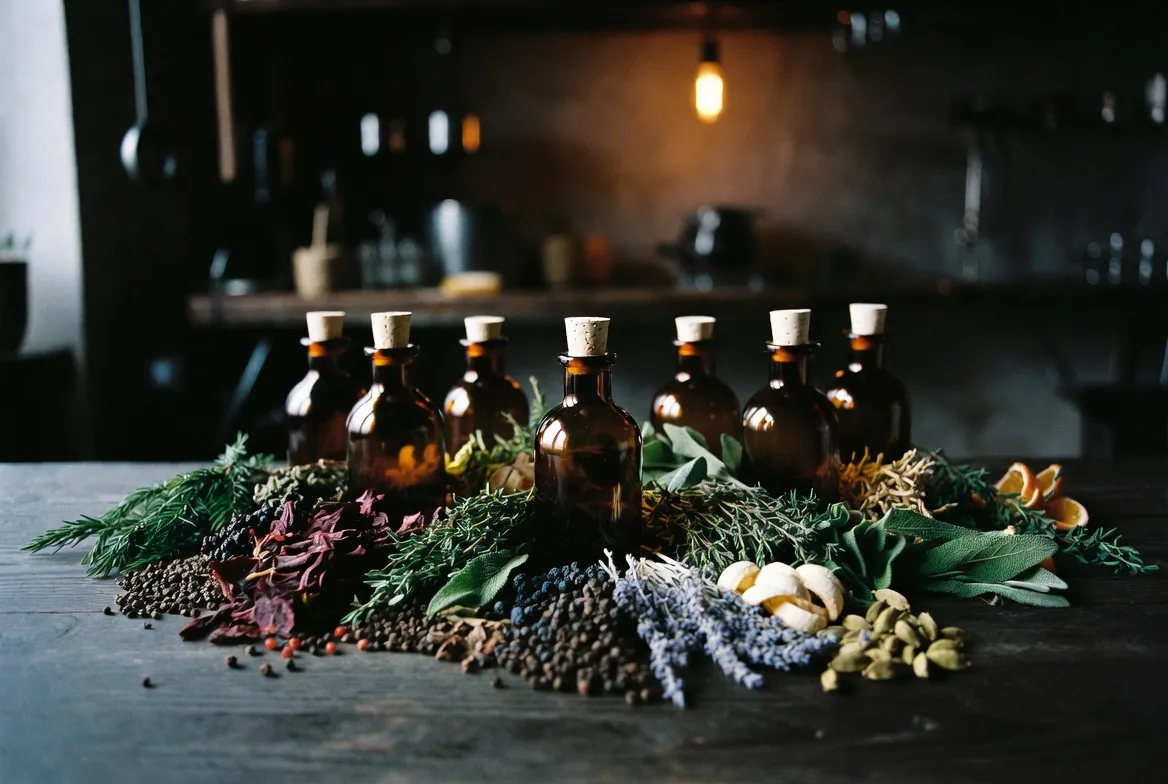
Monkey 47 is one of the most polarizing gins in the contemporary market. Drinkers either consider it the most interesting craft gin in the world, or find it overwrought, fussy, and trying too hard. Both positions are defensible. What’s harder to dispute is that Monkey 47 - made in a former farmhouse in Germany’s Black Forest, blended from forty-seven distinct botanicals, hand-bottled in small brown apothecary-style bottles - has done more than almost any other producer to establish that “German gin” is a category worth taking seriously. This is the story of how an Alsatian farmhouse, a British wing commander’s pet monkey, and an obsessive distiller’s manuscript combined to produce a gin that still divides opinion fifteen years after its launch.
The position
Monkey 47 sits at the top of the super-premium gin market. A 50cl bottle retails for £40-50 in the UK, $55-70 in the US - roughly twice the price of a serious mid-tier gin like Tanqueray No. Ten and three times the price of a workhorse like Plymouth. The bottle is small (50cl rather than the standard 70cl), which makes the per-millilitre price even more striking.
The gin is 47% ABV - higher than standard but not navy strength. The label gives the bottle number from a particular batch, the year, and the names of the distillery’s founders. The botanicals are listed (47 of them, though Monkey 47 doesn’t disclose precise proportions). The whole package - the small brown bottle, the cork stopper, the calligraphic label, the apothecary aesthetic - signals “craft” and “premium” before a single drop has been poured.
This presentation is intentional. Monkey 47 was launched in 2010 (at a tasting event in late 2008, commercially from 2010) into a market that was still dominated by mass-market gin brands. Founder Alexander Stein wanted to do something different. The packaging makes the difference visible before tasting.
The origin story - Wing Commander Collins and his monkey
The story Monkey 47 tells about itself is unusually specific. It traces back to a real person: Montgomery “Monty” Collins, a British Wing Commander who served in the Royal Air Force during the Second World War. After the war, Collins moved to the Black Forest region of Germany, where he ran a guesthouse called “Zum Wilden Affen” - “The Wild Monkey.”
Collins was, by accounts, an eccentric. He sponsored an Egyptian monkey at Berlin Zoo, which gave the guesthouse its name. He was also an amateur botanist and home distiller, experimenting with gin recipes that used local Black Forest botanicals. Around 1951, he produced a small batch of gin he called “Max the Monkey,” named after his sponsored monkey. The recipe used a then-unusual approach: multiple local botanicals including lingonberry, spruce, and other foraged ingredients.
Collins died in 1969. The recipe disappeared. The guesthouse was eventually torn down. The story would have ended there.
In 2006, Alexander Stein - a marketing executive with no distilling background - was renovating an old house in Lossburg, in the same Black Forest region. He came across documents referring to Collins’s gin experiments and the Max the Monkey recipe. Stein decided to recreate it.
Stein partnered with Christoph Keller, an experienced distiller who ran the Stählemühle distillery. Together they spent two years developing a gin inspired by the Collins concept - using forty-seven Black Forest botanicals at 47% ABV. They launched commercially in 2010.
The name Monkey 47 references both Collins’s wild monkey guesthouse and the forty-seven botanicals. The whole brand identity grew from the historical foundation - the apothecary bottle, the calligraphic label, the small batch numbering all echo the wartime/post-war era when Collins would have been experimenting.
How much of this story is genuine? The Collins connection is real - Monkey 47 has produced documentation, and the Black Forest region has independent records of Collins and his guesthouse. The specifics of his actual recipe are less verifiable - whether what’s in the bottle today is genuinely what Collins made is harder to confirm. But the founding inspiration is genuine, not invented marketing.
The forty-seven botanicals
The number is the brand’s central concept. Most premium gins use eight to fourteen botanicals. Tanqueray No. Ten uses twelve. Hendrick’s uses eleven. The Botanist uses twenty-two, which was considered radical when it launched. Monkey 47 uses forty-seven.
The full list is published on the distillery’s website. It includes the classical gin botanicals (juniper, coriander, cardamom, angelica root, orris root, citrus peels) alongside more unusual choices grouped into categories:
Black Forest foraged botanicals. Lingonberry, blackberry, blackcurrant leaves, bramble leaves, spruce shoots, hibiscus, jasmine, lavender, lilac, sage, rose hips. Many of these are picked locally during specific seasons.
Tea and herbs. Black tea, green tea, chamomile, lemon balm, lemon verbena, peppermint, sage, thyme.
Spices. Allspice, almond, cardamom, cassia, cubeb pepper, ginger, nutmeg, pepper (black, long, and pink varieties).
Citrus. Bitter orange, sweet orange, lemon peel, pomelo peel.
Other. Sloe berry, kaffir lime, ambretta, dog rose, elder flower, acacia honey.
The production approach: most botanicals are macerated for a period (specifics not publicly disclosed) before distillation in a small copper still. The result is then blended with other distillates and bottled.
The honest question this raises: does forty-seven botanicals actually produce a better gin than twelve? Or does it just produce a more complex one? The Monkey 47 position is that the botanicals work together as a “flavor architecture” - no single botanical dominates, and the complexity is the point. Critics argue the opposite: that with forty-seven competing flavors, no individual character emerges, and the result is a gin that tastes “expensive” rather than distinctive.
This is the central debate about Monkey 47. There’s no objective answer. The drink is genuinely complex; whether that complexity is enjoyable or fatiguing depends on the drinker.
The Black Forest connection
The distillery’s location matters to the product. Monkey 47 operates from a converted farmhouse in Lossburg, in the Schwarzwald (Black Forest) region of southwestern Germany. This isn’t a marketing flourish - botanicals are genuinely sourced from the surrounding forest, and the distillery’s water comes from a local spring.
The Black Forest is one of Europe’s most botanically rich temperate regions. It supports lingonberry, bilberry, sloe, blackberry, spruce, fir, and dozens of medicinal herbs that don’t grow elsewhere in Germany. The distillery’s claim to use Black Forest botanicals as a signature element is verifiable - the lingonberry and spruce specifically are local sourcing.
The water source matters more than is usually credited. The Black Forest’s soft, low-mineral spring water is well-suited to dilution of high-proof spirits - it doesn’t add competing minerality. The distillery’s website discusses the water at length. Whether it actually makes a perceivable difference in the final drink is debatable, but it’s a real technical detail rather than marketing fluff.
The production approach
Monkey 47 is produced in small batches (the distillery doesn’t disclose exact size but it’s described as small). The process:
-
Maceration. Most botanicals are macerated in neutral grain spirit for a period of days to weeks. The exact duration and which botanicals get which treatment isn’t publicly disclosed.
-
Distillation. The macerated mixture is distilled in a copper pot still. Some botanicals are added via vapor infusion (suspended above the liquid during distillation) rather than maceration.
-
Resting. The fresh distillate is rested for around three months in traditional earthenware containers. This is the unusual step - most gins go straight from distillation to dilution and bottling. The three-month rest is claimed to allow the botanical flavors to integrate.
-
Blending and dilution. Multiple distillation batches are blended together and diluted to 47% ABV with local spring water.
-
Bottling. Hand-bottled in 50cl apothecary-style bottles. Each bottle is numbered.
The three-month resting is the most distinctive technical choice. Most premium gins don’t rest - they’re bottled within days of distillation. Whether resting produces a meaningfully different flavor is contested. Monkey 47 argues yes. Skeptics argue the difference is imperceptible.
What it tastes like
Difford’s Guide describes Monkey 47 as having “a complex, layered character with prominent citrus and pine notes, a peppery mid-palate, and a finish dominated by lingonberry and floral elements.” Imbibe Magazine, in a 2018 review, called it “one of the most articulate craft gins available, with a flavour profile that rewards careful attention but punishes casual mixing.” The distillery’s own description: “fresh, lively, juniper-led, with a complex middle of citrus, spice, and red berry notes.”
The points where reviewers tend to agree:
- Juniper is present but not dominant. This is not a juniper-forward gin.
- The citrus notes are noticeable but not the lead.
- The floral elements (jasmine, lilac, rose hip) come through, especially in the finish.
- Lingonberry and other Black Forest berries produce a distinctive red-fruit note.
- The complexity is genuinely high - more individual flavor notes than most drinkers can identify.
The points where reviewers tend to disagree:
- Whether the complexity is pleasant or overwhelming
- Whether the £40-50 price is justified by the experience
- Whether the gin works well in cocktails or only in spirit-forward neat sipping
The Pernod Ricard era
In 2016, Pernod Ricard acquired Monkey 47. This is the standard arc for successful craft producers - independent founding, growth, and eventual acquisition by a major spirits group when the brand becomes valuable enough.
The post-acquisition concern (universal in craft acquisitions) is whether the gin would change. Pernod Ricard would have financial incentives to scale production, which often means simplifying recipes, using cheaper botanical sources, or reducing labor-intensive steps.
The honest assessment: as of 2026, Monkey 47 appears to be produced in substantially the same way as before the acquisition. The bottle hasn’t changed. The 47-botanical recipe hasn’t changed. The distillery still operates from the same Lossburg farmhouse. Production volumes have increased significantly (the gin is much more widely distributed now than in 2014), but the product itself appears consistent.
Whether this remains true for the next decade is open. Pernod Ricard’s pattern with acquisitions varies - some brands they leave alone, others they gradually optimize. For now, the gin in the bottle is recognizably the same product the small founding team created.
The honest verdict
Monkey 47 is a remarkable technical achievement and a divisive drink. The case in its favor:
- Genuinely innovative approach to gin production (47 botanicals, three-month rest, vapor infusion)
- Real terroir - Black Forest sourcing is verifiable and meaningful
- One of the most complex gins on the market - rewards attention
- Visually and culturally distinctive - has helped legitimize German gin as a category
- Made by people who clearly care about the product
The case against:
- Complexity at the expense of definition - the gin is interesting but doesn’t taste like anything specifically
- Expensive relative to alternatives - £40-50 buys a serious gin from any major producer
- Difficult to use in classical cocktails - fights bitter modifiers, dominates citrus drinks
- Brand presentation can feel like marketing theatre - the apothecary aesthetic is sometimes accused of being calculated rather than authentic
Where it deserves a place: as a contemplative neat sipper, in a martini where you want maximum complexity, or in a gin and tonic with carefully chosen botanical garnishes that amplify rather than fight the existing profile. Where it doesn’t earn its keep: as a workhorse, as a negroni base (the Campari fights the floral elements), or as a gin for someone who values traditional juniper-forward style.
How to drink it
For neat sipping or a serious martini: serve very cold, no garnish, let the complexity speak. The drink rewards slow drinking and attention.
For a gin and tonic: use a copa de balón glass, light tonic (Fever-Tree Mediterranean or 1724), and a single careful garnish - a sprig of rosemary or a few black peppercorns. Don’t overcomplicate the garnish; the gin is already doing the work.
For cocktails: it’s best in stirred drinks where the gin leads. The martini and the gin sour both work. Spirit-forward modern cocktails (Last Word, Bramble) can work but require careful proportions. Avoid the negroni and anything heavy with citrus juice.
If you’ve never tried Monkey 47 and you’re curious, buy a 50cl bottle and judge for yourself. It’s expensive enough that it’s a deliberate purchase rather than a casual buy, and divisive enough that you’ll have a strong opinion within the first three drinks. Whether that opinion is positive or negative, you’ll understand why this gin matters to the contemporary spirits market.
Adjacent reading
Inside Plymouth: England's Oldest Working Gin Distillery
Black Friars in Plymouth has been making gin in the same building since 1793. A profile of England's oldest gin producer and the style that took its name.
Inside Ki No Bi: Where Kyoto Botanicals Meet a London Dry Tradition
The story of The Kyoto Distillery and the gin that quietly redefined Japanese gin: yuzu, gyokuro, sansho pepper, and a six-category botanical approach.
Tanqueray No. Ten: The Premium London Dry, Explained
The fresh-citrus variant of the classic gin, distilled with whole grapefruits and chamomile in a small still. How Tanqueray No. Ten became the bartender's choice.