Distilleries GBR
Inside Plymouth: England's Oldest Working Gin Distillery
Black Friars in Plymouth has been making gin in the same building since 1793. A profile of England's oldest gin producer and the style that took its name.
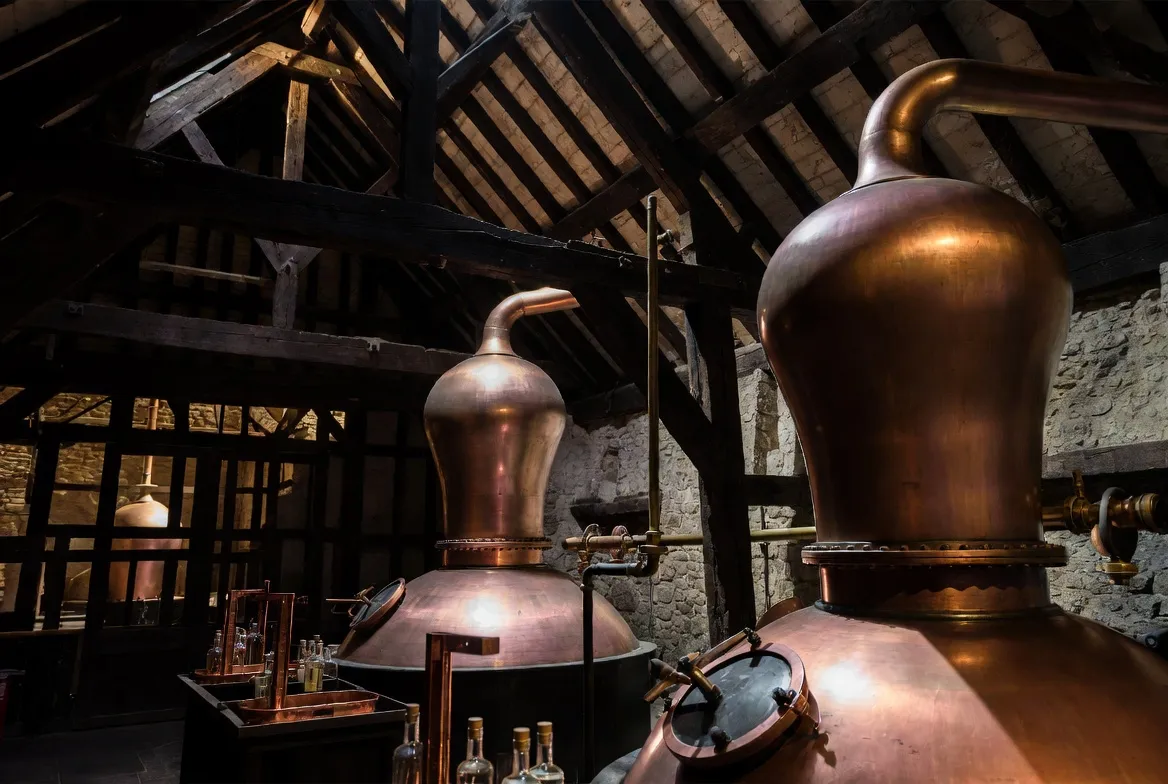
The Black Friars Distillery in Plymouth has been continuously producing gin in the same building since 1793 - longer than any other working gin distillery in England. The building itself is older still, dating back to a Dominican monastery built between 1425 and 1431. Pilgrim Fathers may have spent their final English night in the refectory room before boarding the Mayflower in 1620. The Royal Navy supplied its officer corps with the distillery’s product for over a century. This is the story of a working production facility that’s also a national historical monument, and the gin style that took its name from the town it’s made in.
The building
The Black Friars Distillery sits at 60 Southside Street in Plymouth, a narrow medieval street running down toward the harbour from the city center. The structure was originally a Dominican priory - the “Black Friars” referring to the dark robes worn by Dominican monks - built between 1425 and 1431. When Henry VIII dissolved England’s monasteries in 1536, the building was stripped of its religious function and put to a series of secular uses over the following centuries: a debtors’ prison, a non-conformist meeting hall, and a refuge for Huguenot refugees fleeing French persecution.
The building’s most architecturally significant element is the Refectory Room - the original monks’ dining hall, with a hull-shaped timber-beamed ceiling that has survived essentially unchanged for nearly six hundred years. The Refectory is one of the oldest intact medieval rooms in any English city, and today is open to distillery visitors. The room is large enough to hold around 60 people for dining, and tours typically conclude here with a Plymouth Gin and tonic served at the wooden tables.
In 1620, a group of Pilgrim Fathers gathered in the Refectory before walking the short distance down to the Sutton Harbour, where the Mayflower waited. From there, they sailed for the New World, where they would found Plymouth, Massachusetts. The Mayflower remains on Plymouth Gin’s trademark label today, anchored to this specific historical moment.
The distillery begins, 1793
The Coates family joined an established distilling business operated by Fox & Williamson on the Black Friars site in 1793. The site had records of a “mault-house” (a malt distillery for whisky-style production) dating back to at least 1697, but Plymouth Gin specifically dates from when the Coates family took over and shifted production toward juniper-based spirits.
The new business soon became known simply as Coates & Co. The Coates name remained on the labels until March 2004 - a continuous family-and-firm identity spanning over two hundred years.
The product Coates produced from the start was different in character from the lighter London style that was emerging in the same period. Plymouth Gin used:
- A higher proportion of root botanicals (angelica root, orris root)
- Less citrus peel than typical London Dry
- Sweet orange and green cardamom as distinctive secondary notes
- Soft Dartmoor spring water from the surrounding region for dilution
The result was a fuller, slightly sweeter, more earthy gin than the increasingly dry London style. This characterised “Plymouth gin” became its own recognized style, distinct from London Dry, with its own bar of admirers.
The Royal Navy era
The Royal Navy was the Coates family’s most important customer for over a century. Plymouth was one of the Navy’s three major dockyards (alongside Portsmouth and Chatham), and the gin distillery sat almost literally at the harbour gates. The Navy’s standard practice was to issue rum to ratings and gin to officers - the officers’ mess on a Royal Navy ship was effectively a guaranteed market for Plymouth Gin from the late 18th through the 20th century.
This military connection shaped the brand in lasting ways:
-
The Navy Strength specification. Plymouth produced (and still produces) a 57% ABV navy strength variant - higher proof than standard gin, suitable for the historical Navy practice of testing gin’s alcohol content by mixing it with gunpowder and igniting it (the “proof”). Plymouth Navy Strength is now widely regarded as one of the standard navy strength gins.
-
Global distribution via Naval ships. Plymouth Gin traveled to every part of the British Empire on Naval vessels. By the late 19th century, the brand was familiar in ports across the world, from Singapore to Sydney to New York.
-
The “Plymouth” identity as nautical. The Mayflower-on-the-label imagery, the harbor-adjacent distillery, the Navy supply - all combined to position Plymouth Gin as essentially the gin of the sea, which it largely was.
By the 1850s, Coates & Co. was shipping over 1,000 cases per week to New York alone. The brand was internationally famous in a way few gin producers were in the pre-modern era.
The legal status - then and now
In the 1880s, London distillers attempted to market gins called “Plymouth Gin.” On 13 March 1884 and 10 February 1887, Coates obtained injunctions preventing London producers from using the name. These court victories effectively established Plymouth Gin as a geographically-specific category - only gin produced in Plymouth could legally be called Plymouth Gin.
This protection was formalized in 2014 when the European Union granted Plymouth Gin Protected Geographical Indication (PGI) status. Under EU rules, only gin produced at the Black Friars Distillery in Plymouth could carry the name.
However, in late 2014, Pernod Ricard (which had owned the brand since 2008) announced that it would not renew the PGI status when it expired. The reason: EU regulations required protected products to disclose their full recipe and production process, and Pernod Ricard preferred to keep Plymouth Gin’s recipe confidential rather than make it publicly documented. The PGI lapsed.
This is a peculiar status. Plymouth Gin is no longer legally a protected geographical indication. But it remains the only gin produced in Plymouth, and the historical legal precedents (the 1884 and 1887 injunctions) still effectively prevent other producers from using the name. The category exists, the protection is informal but real, and Pernod Ricard retains commercial monopoly through being the only producer.
The recipe (what’s known)
Plymouth Gin’s recipe has been kept secret since the company began production in 1793. The known elements:
- Seven botanicals total (less than most contemporary craft gins)
- Juniper berries (the foundation, sourced traditionally from Italy)
- Sweet orange peel
- Cardamom (green)
- Coriander seed
- Angelica root
- Orris root
- Two further botanicals that are not publicly disclosed
The production uses copper pot stills. The two main stills are named “Mr. Coates” and “Mrs. Coates” - a piece of working-distillery folklore. Distillation is single-distilled (one pass through the pot still), with the botanicals macerated in neutral spirit before distillation. Dartmoor spring water is used for dilution.
The standard Plymouth Gin bottling is 41.2% ABV. The Navy Strength variant is 57% ABV. A higher-proof “Sloe Gin” variant (using sloeberries macerated in Plymouth Gin) is also produced, mainly for the UK market.
The Pernod Ricard era
Plymouth Gin has passed through several corporate owners. The Coates family sold the business in the mid-20th century. Subsequent owners included Seager Evans, Whitbread (the now-defunct English brewery group), and Allied Domecq, all of which maintained the Coates & Co. name on the products. Allied Domecq sold the brand to the Swedish V&S Group (best known for Absolut Vodka) in 2005. V&S was acquired by Pernod Ricard in 2008, bringing Plymouth into the world’s second-largest spirits group.
The Pernod Ricard era has been broadly stable for the product. Production remains at Black Friars. The recipe hasn’t changed (publicly). The Navy Strength variant remains in production. The distillery tours operate continuously - around 30,000 visitors per year - and the Refectory Room is still the centerpiece of the visitor experience.
Pernod Ricard has, however, deprioritised Plymouth Gin compared to its faster-growing brands. The marketing budget is small compared to Beefeater (Pernod Ricard’s other major gin brand) or Absolut. International distribution has held steady but not grown. Plymouth Gin remains a respected category but not an aggressively-promoted one.
What it tastes like
Difford’s Guide describes Plymouth as “a smooth, gently spicy, slightly sweet gin with a distinctive earthy character and notable cardamom on the finish.”
Reviewers consistently identify:
- Less juniper-forward than London Dry. Juniper is present but recessive.
- Distinctive earthy character. From the angelica and orris roots - a savory, slightly mineral note that London Dry typically lacks.
- Cardamom-led mid-palate. Green cardamom is one of the few publicly-confirmed botanicals and contributes a characteristic warmth.
- Sweet orange rather than bitter orange. Most London Dries use bitter orange peel; Plymouth uses sweet orange, which gives the gin a slightly rounder citrus character.
- Soft finish. The Dartmoor spring water dilution produces a softer, less aggressive finish than many higher-mineral water gins.
The overall impression: classical but distinct, dry but rounder than London Dry, made for cocktails but worth sipping neat. It’s the gin most cocktail historians recommend for classical pre-Prohibition drinks (the Martinez, the Bronx, the original Gimlet) because it sits closer to how gin tasted in the late 19th century than contemporary London Dry does.
Visiting
The Black Friars Distillery is open to the public year-round. The standard 40-minute tour walks through the history of the building, the distillation process, and concludes with a tasting in the Refectory Room. A longer Connoisseur’s Tour includes a comparative tasting of several Plymouth Gin variants. A Master Distiller’s Tour, available less frequently, goes deeper into the production process.
The distillery is at 60 Southside Street, Plymouth, PL1 2LQ - a five-minute walk from Plymouth city centre and immediately adjacent to the harbour. Ticket prices for the standard tour are typically £10-15. Booking ahead is advisable, particularly in summer and around Mayflower anniversaries.
For anyone interested in gin history specifically, this is the most historically significant working distillery in England. The combination of medieval architecture, continuous 232+ years of production, and the Royal Navy / Mayflower connections makes it more than just a producer - it’s effectively a working museum of English gin.
The verdict
Plymouth Gin doesn’t try to be the most fashionable gin in any given decade. The recipe is stable, the production is traditional, the marketing is restrained. The bottle is consistently in the £25-30 range in the UK, $30-40 in the US - mid-premium, accessible to anyone who wants to try it.
What it offers that newer producers can’t: genuine historical continuity. Plymouth Gin is the gin most likely to taste like what people in 1850 or 1900 or 1950 understood gin to be. For someone who values cocktail history, classical preparation, or just the simple fact that the same product has been made in the same building for 232 years, this matters.
For everyday drinking, Plymouth is a reliable workhorse - excellent in martinis, good in negronis, perfectly serviceable in gin and tonics. For someone building a small home bar, Plymouth would be a defensible choice as the single classical bottle.
For anyone visiting Plymouth, the distillery tour is the only English working gin facility that combines this much history with this much production scale. Worth a half-day if you’re passing through Devon.
Adjacent reading
Plymouth Gin: England's Oldest Gin and Its Own Soft Style
England's oldest working gin distillery, and a style all its own - softer and earthier than a London Dry. Production, palate, and its great classic Martini.
Inside Ki No Bi: Where Kyoto Botanicals Meet a London Dry Tradition
The story of The Kyoto Distillery and the gin that quietly redefined Japanese gin: yuzu, gyokuro, sansho pepper, and a six-category botanical approach.
Inside Monkey 47: The Forty-Seven Botanicals of the Black Forest
Germany's super-premium gin, built on a British WWII pilot's monkey, an Alsatian forest, and forty-seven distinct botanicals. The case for and against.